
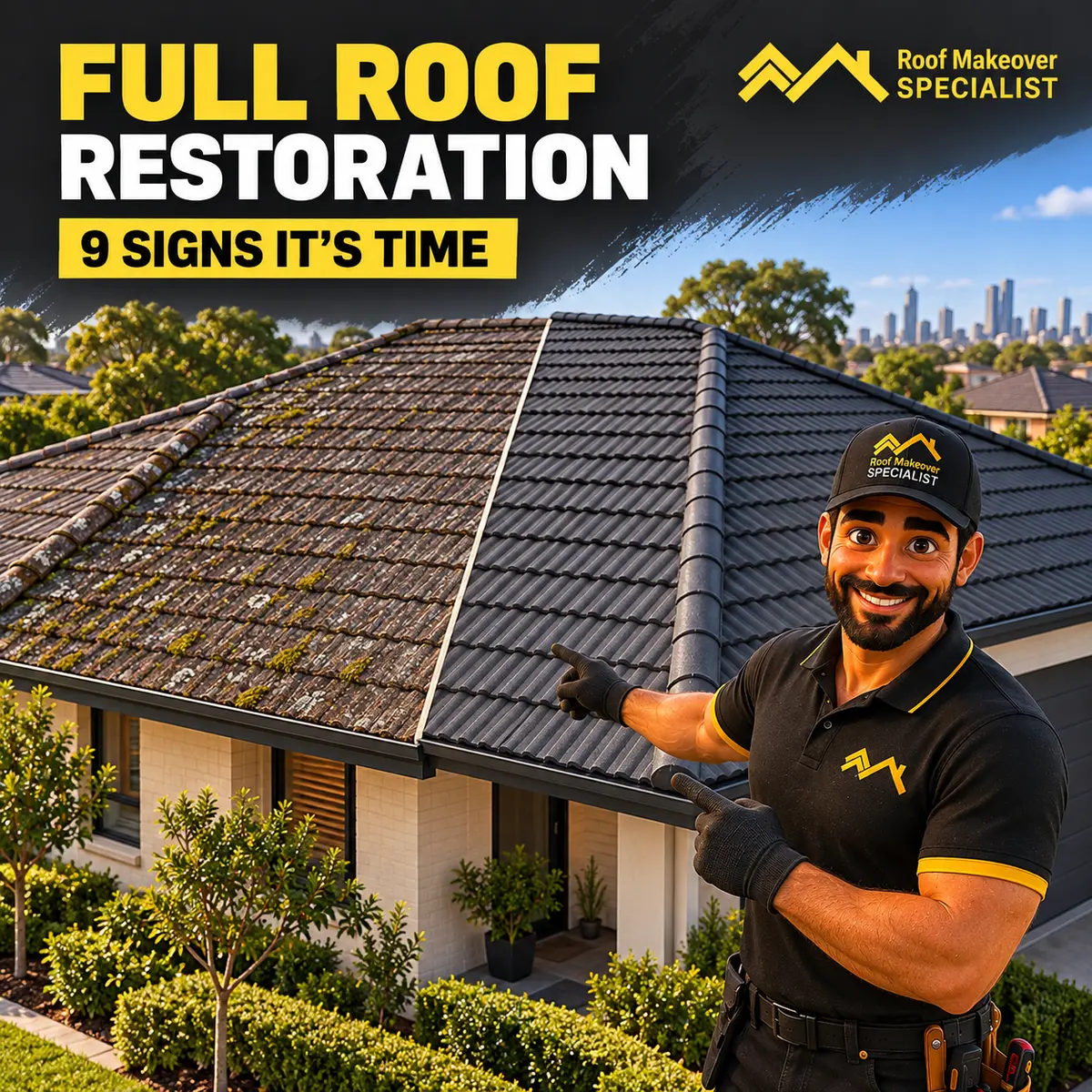
A cracked tile or one loose ridge cap does not automatically mean an entire roof needs restoring. But when wear is spread across the roof, several systems are ageing together and repeated patchwork is no longer addressing the overall condition, a full roof restoration may be the more coherent option. This guide explains nine signs Melbourne homeowners can look for, what a complete restoration should include and why an on-roof assessment must come before any recommendation.
When a full roof restoration makes more sense than isolated work
A complete roof restoration is intended for a roof that remains broadly serviceable but needs coordinated work across more than one area. Instead of treating one visible symptom, the scope considers the roof as a system: tiles, ridge and hip capping, valleys, flashings, penetrations, surface condition and the preparation required before any protective coating is applied.
That distinction matters. One broken tile on an otherwise sound roof may need a limited response. Widespread fading, deteriorated pointing, recurring organic growth and damage across several roof planes can indicate that isolated work will leave most of the ageing roof untouched. A professional roof restoration in Melbourne brings the necessary inspection, cleaning, repairs, preparation and finishing stages into one documented project.
The aim is not to sell the largest possible scope. It is to avoid spending repeatedly on disconnected work when the whole roof is approaching the same maintenance point. Equally, restoration should not be used to disguise roofing material that is no longer dependable. The first decision is always whether the existing roof is suitable to retain.
- ✓Wear or defects appear across several roof sections
- ✓The existing tiles or metal remain broadly serviceable
- ✓Repairs and preparation can be clearly documented
- ✓The surface is suitable for the proposed product system
- ✓A coordinated project offers a more sensible outcome than repeated isolated work
1. Wear appears across multiple roof slopes
Start by looking at the roof as a whole from safe ground-level positions. If the same signs of age appear on the front, rear and side roof planes, the issue may be broader than one localised defect. Look for repeated colour loss, surface wear, cracked tiles, loose capping or inconsistent previous work across several sections.
Different roof slopes do not weather at exactly the same rate. Areas exposed to stronger sun can fade sooner, while shaded sections may hold moisture and organic growth. Even so, widespread deterioration across differently oriented slopes is a useful signal that the roof has reached a whole-of-roof maintenance stage.
Photographing the roof from several viewpoints can help you compare changes over time. Do not climb onto the roof to investigate. Tiled surfaces can be brittle or slippery, and a professional inspection is needed to distinguish visible ageing from defects that require action.
2. Fading, chalking and surface erosion are widespread
Roof colour naturally changes under years of ultraviolet exposure, rain, wind and airborne dirt. Fading alone does not prove that the roof is leaking, but widespread loss of colour can indicate that an old surface finish is nearing the end of its useful life. Concrete tiles may also become more porous or chalky as they weather.
The important word is widespread. A small discoloured patch could relate to shade, run-off or an earlier replacement tile. When most roof planes look washed out, patchy or bare, treating a small section will not create a consistent surface or outcome. The underlying material and any old coating should be assessed across the entire roof.
A full restoration may include pressure cleaning, surface preparation, a compatible primer or sealer where specified and professional finishing coats. Those stages should follow the roof material and condition; a new colour is the visible conclusion of the work, not the diagnosis. Our guide to what a quality roof restoration looks like explains how to assess the finished result using real customer-submitted roof photographs.
3. Moss and lichen keep returning across the roof
Moss, lichen and other organic growth tend to establish where moisture lingers and roof surfaces provide a suitable foothold. Heavy growth can hide cracked tiles, deteriorated pointing and the condition of previous coatings. It can also collect around laps and drainage paths, making a proper inspection more difficult.
A quick wash may improve the appearance, but recurring growth across large areas can signal that cleaning alone is not the complete answer. The roof needs to be cleaned in a controlled way, allowed to dry and then reassessed so newly exposed defects can be included in the scope before finishing work begins.
Cleaning pressure and technique should be appropriate for the roofing material. Aggressive washing is not a substitute for preparation, and painting over remaining organic material can compromise adhesion. In a full restoration, cleaning is one stage within a deliberate sequence rather than the entire service.
4. Ridge and hip capping have deteriorated across the roof
Ridge caps run along the roof peaks, while hip caps follow the sloping external junctions. On many older tiled roofs, the bedding mortar and pointing around these caps deteriorate gradually. Fine cracking in one short section may be localised, but loose caps, open joints or crumbling material across multiple ridge and hip lines suggest a broader maintenance requirement.
The correct treatment depends on what the inspection finds. Some sections may need rebedding, while sound bedding can sometimes be prepared and finished with compatible flexible pointing. Simply coating over loose or cracked mortar does not restore its stability.
Because ridge and hip lines extend around much of the roof, piecemeal work can leave adjacent aged sections unresolved. A full restoration scope allows the capping system to be assessed consistently and completed before the finishing coats. The tile roof restoration service explains how concrete and terracotta roofs require material-specific decisions.
5. Broken, cracked or displaced tiles are no longer isolated
A single storm-damaged tile can be an isolated event. Several cracked, slipped or poorly seated tiles in different areas can point to more general ageing, foot traffic, movement or deterioration. The number of visible defects is only part of the picture; compatible replacement tiles, surrounding tile condition and roof geometry also matter.
During a restoration assessment, accessible roof areas should be checked systematically rather than only where a leak has already appeared. Pressure cleaning may expose fine cracks or unstable tiles that were concealed by grime and growth, so the final repair allowance should reflect what can reasonably be confirmed before and after cleaning.
Broken tiles must be addressed before the finishing system is applied. Coating cannot bridge a structural crack or make an unsuitable tile serviceable. A clear quotation should state how tile replacement is allowed for, how additional defects will be documented and what happens if matching profiles are difficult to source.
6. Leaks or ceiling stains point to more than one vulnerable area
Water stains, damp smells or marks that return after heavy weather deserve investigation. Water can travel along underlay, battens and roof junctions before appearing inside, so the internal stain may not sit directly below the entry point. One visible leak can also have more than one contributing defect.
If staining appears in different rooms, returns after previous work or occurs around several roof junctions, the inspection should consider the broader roof condition. Valleys, flashings, ridge lines, penetrations, broken tiles and drainage paths may all need to be reviewed within one scope.
A full restoration can address agreed leak sources when the roof remains suitable, but it should never be sold as a blanket cure for every possible water issue. Hidden structural defects, plumbing, condensation or areas outside the documented scope may require separate investigation. The value of the restoration is a coordinated, transparent approach—not an unrealistic promise.
7. Previous patchwork has created an inconsistent roof
Older roofs often carry a history of replacement tiles, sealant, small repointing sections and earlier coatings. Some of that work may still be sound. Problems arise when short-term fixes accumulate without anyone reassessing how the complete roof is ageing.
Look for visibly mismatched tile profiles, repeated sealant in different locations, fresh mortar beside crumbling sections or several colours and coating conditions across one roof. These signs do not automatically make restoration necessary, but they should prompt a whole-roof inspection rather than another assumption about the nearest visible defect.
A complete restoration can reset the maintenance approach by documenting what will be retained, replaced, repaired and coated. It also creates a clearer handover record for the homeowner. Existing patchwork must still be assessed for compatibility; unsuitable material cannot simply be covered and forgotten.
8. An old coating is peeling, chalking or failing widely
Previous roof coatings can deteriorate through age, inadequate original preparation, product incompatibility or prolonged exposure. Peeling edges, widespread chalking, flaking and uneven adhesion are warning signs because a new system is only as dependable as the surface beneath it.
Applying another colour coat over unstable material can trap the problem under a fresher appearance. The old surface needs to be inspected after cleaning, and additional preparation may be required before any compatible system is considered. In some cases, the condition of the previous coating can change the practicality or price of the project.
This is one reason a full written scope matters. It should identify the existing surface, the proposed preparation and the product sequence—not merely promise a number of coats. Our step-by-step roof restoration process guide explains how inspection, cleaning, repairs, drying, priming and finishing should connect.
9. The roof is ageing—but still serviceable enough to restore
The final sign is also the most important qualification: the existing roof still needs to be worth retaining. Restoration is designed to renew serviceable roofing, not postpone inevitable failure with a cosmetic layer. Age by itself does not decide the answer; tile integrity, metal condition, roof movement, flashings, drainage and the supporting structure all contribute.
A roof with widespread but repairable maintenance needs can be a strong restoration candidate. A roof with severe material breakdown, extensive corrosion, persistent movement or repeated failure across the system may be better considered for replacement. The restoration versus replacement guide explains the different roles of each option.
A trustworthy assessment must be capable of recommending against restoration. That protects the homeowner from investing in a finish that cannot deliver a sensible outcome and protects the integrity of the restoration work itself.
- ✓The main roofing material remains serviceable
- ✓Required defects can be repaired within a clear scope
- ✓The roof can be cleaned and prepared without exposing widespread failure
- ✓The proposed products are compatible with the surface
- ✓Restoration offers a practical outcome compared with replacement
What a complete roof restoration should include
A full roof restoration is not a single product and it is not defined only by the number of colour coats. It is a roof-specific project that joins assessment, repair, preparation and finishing into one sequence. The final quotation should explain that sequence in language you can compare and verify.
For a suitable Melbourne tiled roof, the scope may include safe access and property protection, pressure cleaning, replacement of agreed damaged tiles, ridge and hip work, attention to included valleys or flashings, drying and surface preparation, a compatible primer or sealer where specified, finishing coats, clean-up and a final quality check.
The exact inclusions should change with the roof. Terracotta and concrete tiles are not interchangeable, and metal roofing requires a different approach to fasteners, corrosion, laps, primers and sealants. A standard package copied onto every material is not evidence of a complete restoration.
- ✓Roof inspection and restoration-suitability assessment
- ✓A written scope identifying included repairs and exclusions
- ✓Safe access, masking and surrounding-property protection
- ✓Thorough cleaning followed by drying and reinspection
- ✓Tile, ridge, hip, valley or flashing work included in the quote
- ✓Compatible preparation, primer or sealer where required
- ✓Professional finishing coats and final quality inspection
- ✓Clear handover, product and warranty information
Full roof restoration and roof painting are not the same service
Roof painting focuses on preparing and coating a suitable surface. A full restoration ordinarily includes a broader condition assessment and an agreed repair scope before coating begins. The services can overlap, but the words should not be used to hide what is missing from a quotation.
For example, a quote that includes pressure cleaning and colour coats but says nothing about broken tiles, ridge capping, flashings or surface defects may be a painting scope rather than a complete restoration. That is not automatically wrong if the roof needs only painting, but the homeowner should understand the distinction.
Ask the contractor to separate repair, preparation and coating stages. Our professional roof painting page describes the coating-focused service, while the main roof restoration page sets out the wider restoration approach.
How to compare full roof restoration quotes
Compare proposed outcomes rather than looking only at the final figure. Two quotes can use the phrase full restoration while allowing for very different work. Place them side by side and identify what each says about access, cleaning, tile replacement, ridge work, previous coatings, primers, finishing products, property protection and final inspection.
Vague repair allowances deserve questions. Phrases such as repair where required may be unavoidable before cleaning exposes the complete surface, but the contractor should still explain what is visible, what has been included and how additional work will be approved. A clear variation process is better than pretending every hidden condition is already known.
The lowest quote may suit a roof that genuinely needs less work. It may also exclude stages another contractor considers essential. Our Melbourne roof restoration cost guide outlines the roof size, pitch, access, material and condition factors that influence a responsible quotation.
Roof Makeover Specialist focuses on substantial roofing projects and does not take on jobs under $5,000. That minimum is shown near the enquiry form so homeowners can decide whether the service is likely to suit their project before submitting.
- ✓Is the roof material and existing coating clearly identified?
- ✓Which tiles, ridges, hips, valleys or flashings are included?
- ✓How will the roof be cleaned, dried and reassessed?
- ✓Which primer, sealer and coating system is proposed?
- ✓How are solar panels, walls, windows and neighbouring property protected?
- ✓What is excluded and how are variations approved?
- ✓What final inspection and handover information will be provided?
How Melbourne conditions affect a restoration project
Melbourne weather influences both the ageing roof and the project schedule. Sun exposure can fade coatings, shaded sections can retain moisture, storms can move or break tiles and rapid weather changes can interrupt cleaning or application days. The roof may show a different condition on each orientation even when all sections are the same age.
During the work, suitable drying and application conditions matter. Rain, strong wind, heavy dew and roof-surface temperature can affect when primers, sealers and coatings should be applied. A professional schedule needs enough flexibility to pause rather than compress preparation or coat over a damp surface.
Property protection also matters in closely spaced suburbs. Pressure-cleaning run-off and coating overspray need to be controlled around windows, walls, vehicles, gardens, solar panels and neighbouring homes. These practical steps belong in the planning of a complete restoration.
What a full restoration cannot promise
A well-scoped restoration can renew a suitable roof, address agreed defects and improve its appearance and weather protection. It cannot make every roof new, guarantee hidden areas that could not be inspected or compensate for structural failure outside the scope.
Be cautious of universal lifespan claims or statements that one system suits every roof. Product performance depends on the existing material, preparation, application, exposure and maintenance. Warranties should be read for their actual coverage, conditions and responsible party.
A professional recommendation should be specific about the expected outcome and its limits. That honesty is more useful than a broad promise because it gives the homeowner a realistic basis for deciding between restoration and replacement.
How to decide whether to act now
You do not need to wait for water to enter the home before arranging an assessment. If several of the signs in this guide appear across the roof, inspecting it while the material remains broadly serviceable may preserve more options than waiting for deterioration to advance.
Begin with safe observations: note which slopes look faded, where growth is heaviest, whether ridge lines appear uneven and when any internal stains occur. Collect previous quotes, invoices or product information if available. These details help the contractor understand the roof’s history before completing an on-roof assessment.
You can also watch our roof restoration warning-sign video and explore the Melbourne roof restoration service-area directory for local information. Neither replaces an inspection, but both can help you prepare useful questions.
Arrange a full roof restoration assessment
When ageing is widespread but the roof remains suitable to retain, a complete restoration can be a more coherent project than continuing with disconnected patchwork. The key is a roof-specific scope: inspect first, document the defects, clean and prepare properly, complete the agreed repairs, use compatible products and check the finished roof against the quotation.
Visit our full roof restoration service for Melbourne homes to see the complete approach, or call 1300 ASK 4 US to arrange a free roof inspection. Tell us what you have noticed and we will assess whether restoration, replacement or another substantial roofing solution is appropriate.
Common questions
Roof Restoration FAQs
What is included in a full roof restoration?+
A roof-specific restoration can include inspection, safe access and property protection, pressure cleaning, agreed tile and ridge repairs, drying and surface preparation, a compatible primer or sealer where specified, finishing coats, clean-up and final inspection. The exact scope should follow the roof material and condition.
Is a full roof restoration the same as roof painting?+
No. Roof painting focuses on surface preparation and a compatible coating system. A full restoration generally includes a broader roof assessment and an agreed set of repairs before finishing work begins. A written quote should make the difference clear.
How do I know whether my roof needs restoration or replacement?+
Restoration may suit a roof whose main materials and structure remain broadly serviceable and whose defects can be repaired within a clear scope. Widespread material failure, structural movement, extensive corrosion or repeated system failure may make replacement more practical. An on-roof assessment is required.
How long does a complete roof restoration take?+
Many residential restorations take several working days, but roof size, pitch, access, repair requirements, drying time, product specifications and Melbourne weather all affect the schedule. The contractor should explain the expected sequence rather than promise one universal duration.
Can a full roof restoration address roof leaks?+
It can address agreed leak sources when the roof remains suitable for restoration, but the cause must be investigated first. Water can enter through tiles, ridges, valleys, flashings, penetrations or other building issues, and hidden or excluded defects cannot responsibly be guaranteed.
Does Roof Makeover Specialist take on small repair-only jobs?+
Roof Makeover Specialist focuses on substantial roof restoration and roofing projects and does not take on jobs under $5,000. A free inspection can help determine whether your roof is suitable for a complete restoration or another larger-scope service.