
A rusted or badly faded corrugated roof can look as though replacement is the only option. Sometimes it is. But when the sheets remain structurally serviceable, the corrosion is treatable and the roof can be prepared for a compatible system, a complete metal roof restoration may renew the existing roof without removing every sheet. This guide uses photographs from two genuine Roof Makeover Specialist projects to explain how that decision is made, what a professional restoration should include and which warning signs can make replacement the more responsible recommendation.
The short answer: some rusted tin roofs can be restored
A rusted tin roof may be restorable when the visible corrosion is mainly at the surface, the sheets have not become perforated or dangerously thin, the roof structure remains sound and defects around fasteners, flashings, laps and penetrations can be repaired within a clear scope. The coating system must also be compatible with the existing metal and whatever finish remains after preparation.
Restoration is not the same as painting over rust. The roof must first be assessed as a complete system. Cleaning and preparation expose the real condition; repairable defects are addressed; affected metal is treated according to the specified system; suitable primers are applied where required; and only then can the protective finish be completed. Our metal roof restoration service in Melbourne explains how we assess and restore suitable corrugated metal roofing.
A roof with deep corrosion, holes through the sheets, failing side laps, widespread metal loss or structural movement may not be a sensible restoration candidate. In those cases, roof replacement can provide a more dependable result than investing in a coating over material that is no longer serviceable. The purpose of the inspection is to determine which category the roof actually falls into—not to assume restoration or replacement from a ground-level photograph.
- ✓Surface corrosion can sometimes be treated when the metal remains sound
- ✓Perforation and widespread sheet failure can make replacement more appropriate
- ✓Fasteners, laps, flashings and penetrations matter as much as roof colour
- ✓Preparation and product compatibility determine whether a coating system is suitable
- ✓An on-roof inspection should come before a restoration recommendation
Tin roof, iron roof or metal roof: what do homeowners mean?
Melbourne homeowners often use the terms tin roof, iron roof and metal roof interchangeably. Older Australian houses are also commonly described as having corrugated iron, even when the installed roof is coated steel or another metal product rather than a sheet made from pure tin or iron. The everyday phrase is useful for search and conversation, but it is not precise enough for a restoration specification.
The actual substrate, age, existing coating and corrosion pattern influence how the roof should be prepared. Galvanised steel, zinc-aluminium coated steel and pre-painted steel products can require different decisions, particularly where the original finish has weathered or previous coatings are present. A contractor should identify the existing surface as accurately as practical rather than treating every corrugated roof as the same material.
That is why this guide uses metal roof restoration as the technical umbrella term while still answering the common question about a rusty tin roof. Whatever the homeowner calls it, the roof has to be inspected and the proposed products checked for compatibility with the prepared surface.
What makes a metal roof suitable for restoration?
A good restoration candidate still has useful roofing material to retain. The roof may look faded, chalky or rusty, but its sheets remain sufficiently sound; local defects can be repaired; water can drain correctly; and the existing surface can be cleaned and prepared without revealing failure across the system. The roof structure and safe access also need to support the proposed work.
The inspection should cover more than the most photogenic roof plane. Corrugation valleys, sheet ends, side and end laps, ridges, gutters, flashings, valleys, skylights, vents, chimneys and other penetrations can hold debris or moisture and may deteriorate at different rates. Fasteners and washers also age, and movement around them can contribute to water entry even when the broad sheet surface still looks reasonable.
Restoration becomes a practical option when those elements can be brought into one coordinated scope. If the roof needs isolated work only, a roof repair assessment may be enough. If ageing and coating breakdown are widespread but the system remains serviceable, a full restoration can make more sense than repeatedly treating one small area at a time.
- ✓The sheets remain serviceable after close inspection
- ✓Corrosion is treatable within the proposed system
- ✓Defective fasteners, seals and flashings can be addressed
- ✓Drainage paths and roof geometry remain practical
- ✓The surface can accept a compatible primer and coating system
- ✓The written scope covers the whole roof rather than hiding exclusions
When rust means the roof may need replacement
Rust is not a single condition. Light surface staining is very different from metal that has flaked away, become pitted through its thickness or developed holes. Corrosion hidden under laps, around fasteners or beneath accumulated debris can also be more advanced than the visible roof field suggests. A coating cannot rebuild missing steel or restore strength to a sheet that has lost its integrity.
Replacement should be considered when corrosion is widespread or perforating, many sheets have failed at the same vulnerable locations, repair work would be extensive and short-lived, or the supporting roof system has significant defects. Persistent ponding, incompatible metals and recurring leaks across several junctions can also change the value equation.
A responsible contractor should be prepared to recommend against restoration. The roof restoration versus roof replacement guide explains the broader decision, while the free roof inspection service gives Melbourne homeowners a practical starting point. The best result is not always the least expensive scope today; it is the scope suited to the roof that will remain after the work.
The complete metal roof restoration process
The exact sequence changes with the roof, weather and specified product system, but a professional metal restoration should connect assessment, preparation, repairs and finishing in a deliberate order. It should not begin with a colour choice and work backwards. The visible finish is the final stage of a much more important substrate-preparation process.
Before work starts, the contractor should document the roof material as far as practical, visible corrosion, old coatings, access, penetrations, drainage and surrounding property that needs protection. The written quotation should distinguish included repairs from possible variations that can only be confirmed after cleaning exposes the surface.
A typical full restoration for a suitable corrugated metal roof may include the following stages.
- ✓Inspect sheets, laps, fasteners, flashings, gutters and penetrations
- ✓Confirm whether the roof is suitable to retain
- ✓Protect walls, windows, solar equipment and neighbouring property
- ✓Remove debris and clean the roof using a suitable method
- ✓Allow the surface to dry and inspect it again
- ✓Complete agreed fastener, sealing, flashing and local sheet work
- ✓Prepare and treat corrosion within the specified system
- ✓Apply compatible primers and protective colour coats where required
- ✓Check coverage, junctions, drainage areas and the cleaned work site
Project one: from widespread corrosion to a green metal roof finish
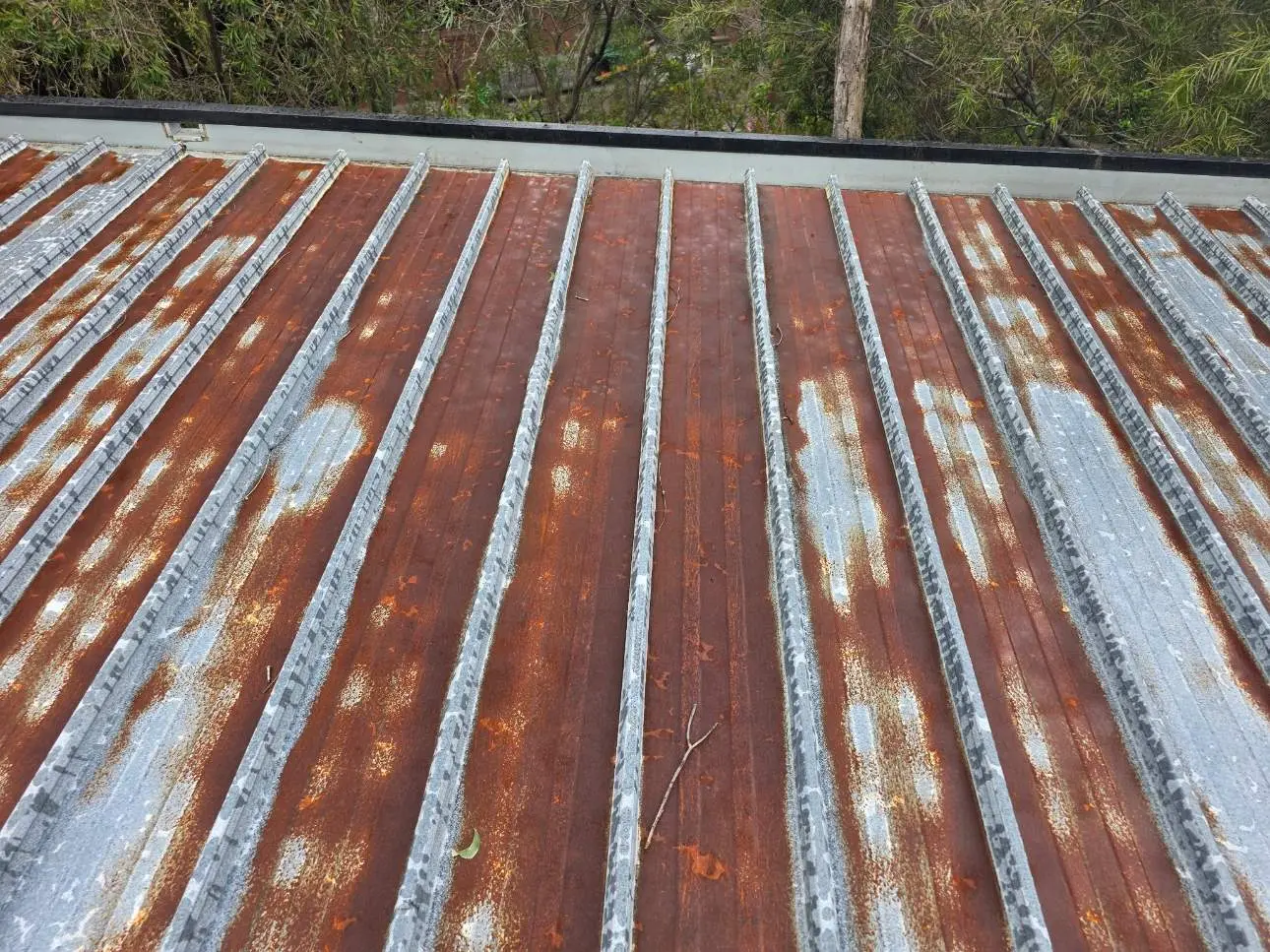
The first real project supplied for this guide shows a low-pitched corrugated roof surrounded by mature trees. Before the finished coating, large areas of the roof surface showed red-brown corrosion and exposed-looking sections between the raised ribs. This is the kind of roof where a distant photograph cannot answer the restoration question: the apparent severity makes close inspection and preparation essential.
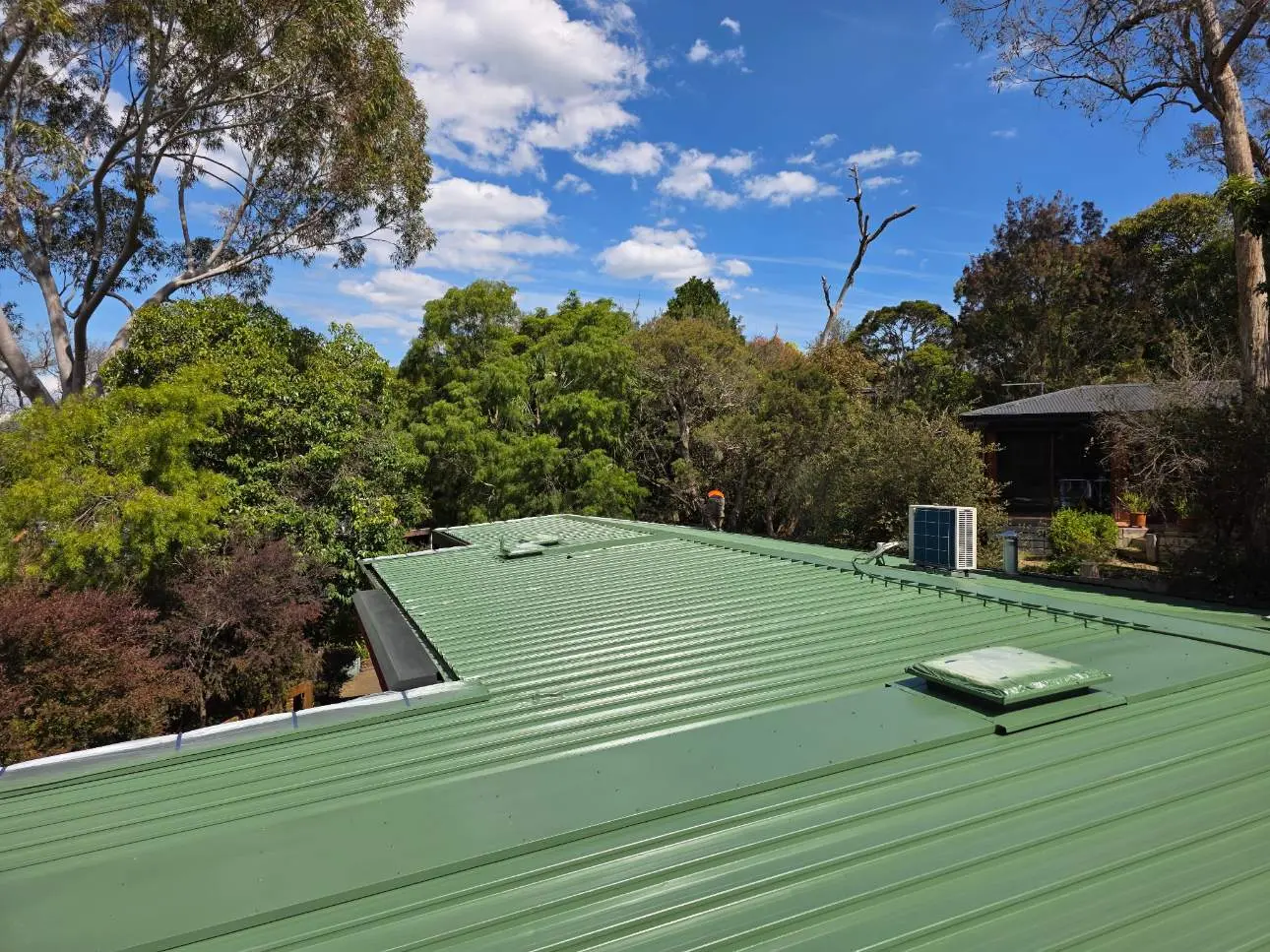
The completed photographs show a consistent green finish across the main roof planes, ridges, sheet profiles and visible roof features. The surrounding walls, gutters, vegetation and equipment also make property protection and controlled application important parts of the job—not minor details to be considered after coating begins.
The transformation demonstrates what a full metal roof restoration can achieve when the underlying roof is suitable. It should not be interpreted as evidence that every roof with similar-looking rust can be saved. The amount and depth of corrosion, sheet integrity and condition at laps or penetrations still decide whether restoration is responsible.
Cleaning reveals the condition; it does not complete the restoration
Debris, dirt, organic growth and unstable old coating can hide corrosion and interfere with adhesion. Cleaning removes contaminants and loose material so the roof can be evaluated more accurately. Manufacturer maintenance guidance also highlights debris build-up, possible ponding locations and metallic staining as areas that deserve investigation rather than being ignored.
The cleaning method must suit the surface and property. Excessively aggressive preparation can damage remaining protective layers, while inadequate cleaning can leave material that compromises the next coat. Run-off, gutters, surrounding gardens, windows, walls and adjacent homes need to be considered before washing begins.
After cleaning, the roof should be allowed to dry and reassessed. That second look matters because corrosion, failed sealant, worn fastener washers or weak previous coatings can become clearer once grime has been removed. The scope should allow for responsible documentation and approval if the revealed condition differs materially from what could be seen during the first inspection.
Corrosion treatment, preparation and primer compatibility
Corroded areas require preparation appropriate to their severity and the nominated coating system. Loose rust, unstable coating and contamination must be dealt with; repair or replacement may be necessary where metal has failed; and the specified treatment or primer must be compatible with both the substrate and the new finish. Simply spraying a generic paint over orange rust is not a professional restoration specification.
The remaining old coating also matters. A surface that appears sound may still be chalky or poorly bonded. Adhesion, previous products and the exposed metal all influence what should happen next. Product manufacturers describe roof membranes as suitable for properly prepared metal roofs, with surface preparation tied to the actual substrate and specified finish—not as a shortcut that makes preparation optional.
Ask the contractor to name the proposed system and explain where primers, sealers or other preparation products are required. The answer should connect to the roof in front of them. Our roof painting service explains the coating-focused work, while the main metal roof restoration page covers the broader repair-and-preparation scope.
Fasteners, laps, flashings and roof penetrations must be included
Metal sheets expand and contract as temperatures change. Fasteners, washers, laps, flashings and sealants experience that movement repeatedly, so leaks and deterioration are often concentrated around junctions rather than the middle of an otherwise sound sheet. Skylights, flues, vents, chimneys and roof-mounted equipment create additional transitions that need inspection.
A quote should state which defective fasteners will be replaced, which junctions or flashings are included, and how penetrations will be protected during preparation and coating. Painting over an aged washer or failed seal does not repair it. Likewise, applying more sealant without understanding the junction can make later diagnosis harder.
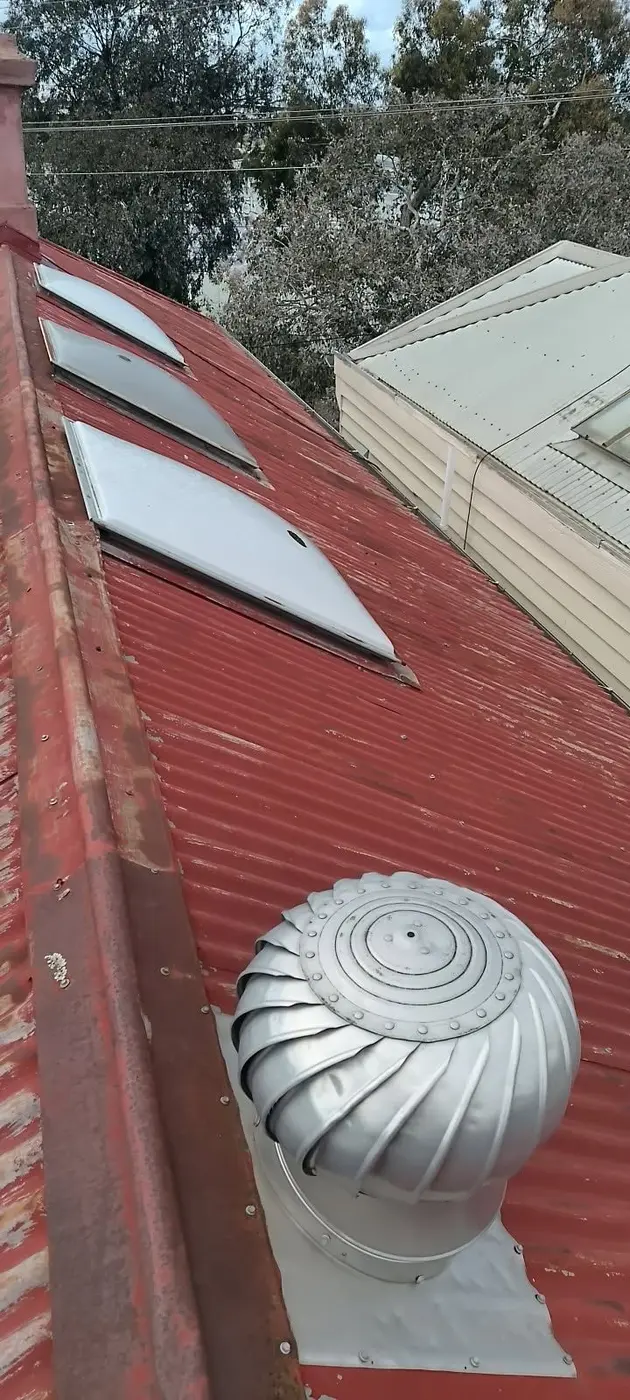
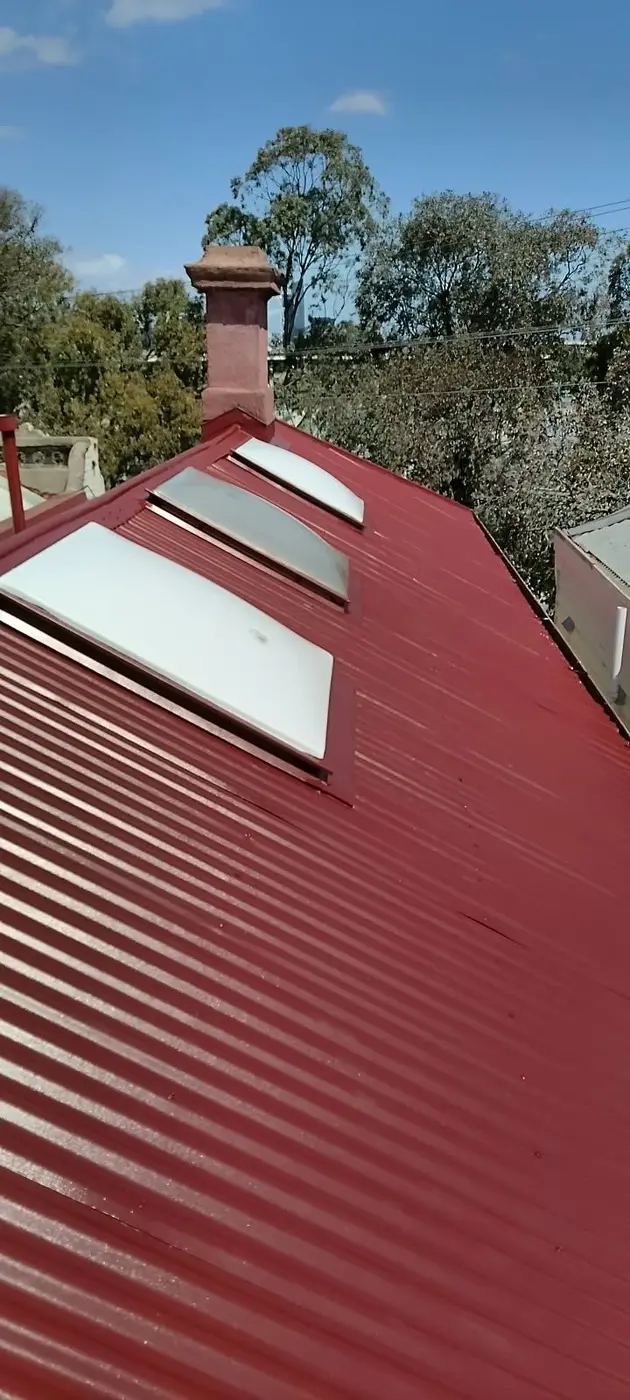
The second real project in this guide includes skylights, a chimney, roof vents and other penetrations. Those features make the quality of masking, edge work and junction assessment visible in a way that a simple roof-plane photograph cannot. They are part of the roof system and should be treated as part of the scope.
Project two: renewing a weathered red corrugated roof
The second project shows a steeper corrugated roof with a heavily weathered red surface. In the before photographs, colour loss and bare-looking streaks extend across a large portion of the roof rather than one small patch. This is a useful example of why a whole-roof restoration can be more coherent than isolated touch-ups when the existing material remains suitable.
The completed photographs show a uniform deep red finish across the principal roof planes, ridge line and the areas surrounding visible penetrations. The roof retains its established colour character while presenting a consistent renewed surface. Because the building form includes skylights and a masonry chimney, clean edges and careful protection are especially important to the finished appearance.
These images document an authentic Roof Makeover Specialist result without inventing a suburb, product name or warranty that the photographs do not establish. Homeowners comparing similar work should still ask for a project-specific written scope, product details and confirmation that their own roof is suitable to restore.
Metal roof restoration, repairs and roof painting are different scopes
A metal roof repair addresses a defined defect, such as an isolated fastener, flashing or damaged section. Roof painting concentrates on preparing and coating a suitable surface. A full metal roof restoration brings condition assessment, agreed repairs, corrosion preparation and the protective coating system into one coordinated project. The services can overlap, but the quotation should make the scope clear.
If deterioration is widespread, a small repair may leave most of the ageing surface unchanged. If a quote includes cleaning and colour coats but says little about corrosion, fixings or penetrations, it may be closer to a painting scope than a full restoration. Neither service is automatically wrong; the important point is whether it matches the roof and the homeowner understands what is included.
Roof Makeover Specialist focuses on substantial roof projects and does not take on jobs under $5,000. For a roof with one localised problem, our roof repair information can help explain the distinction. For a complete metal makeover, begin with the Melbourne metal roof restoration service and arrange an inspection.
How to compare metal roof restoration quotes
Two quotations can both say metal roof restoration while describing very different work. Compare the roof-specific diagnosis and sequence rather than counting only the number of colour coats. A detailed quote should show that the contractor has considered access, material type, corrosion, old coatings, fasteners, flashings, penetrations, preparation, property protection and the final inspection.
Ask what happens if cleaning reveals deeper corrosion or failed material. A reasonable contractor may not be able to see every hidden condition before work starts, but they should explain how additional work will be documented, priced and approved. A transparent variation process is better than a low headline price that assumes every unseen area will be fine.
The proposed products should be identified and connected to the surface preparation. Avoid relying on vague phrases such as premium paint or rust proofing without a system explanation. Also check who will complete the work, how surrounding property will be protected, what exclusions apply and what written handover information will be provided.
- ✓What roofing material and existing coating were identified?
- ✓Is corrosion surface-level, localised, deep or widespread?
- ✓Which sheets, screws, washers, laps and flashings are included?
- ✓How will the roof be cleaned, dried and reassessed?
- ✓What preparation and primer system is proposed for exposed metal?
- ✓How will skylights, walls, gutters, solar panels and neighbours be protected?
- ✓Which defects would trigger replacement or a written variation?
- ✓What final inspection and product information will be supplied?
What affects the cost of a tin or metal roof restoration?
There is no responsible fixed price for every metal roof. Roof area is only one factor. Pitch, height, access, sheet profile, corrosion severity, the condition of fasteners and flashings, previous coatings, penetrations and the amount of masking can all change the labour and product requirements. A compact but complex roof can need more detailed work than a larger simple roof plane.
The biggest cost difference is often the preparation and repair scope. A faded, sound pre-painted surface is a different project from extensive corrosion with failed fixings and several skylights. Quotes that appear far apart may be allowing for different stages, so compare inclusions before assuming one contractor is simply more expensive.
Roof Makeover Specialist provides free roof inspections for suitable substantial projects across Melbourne and selected Victorian areas. The business does not take on jobs under $5,000 and does not provide pre-purchase inspections. For broader budgeting considerations, see the Melbourne roof restoration cost guide, then request a roof-specific metal restoration scope.
How Melbourne conditions influence metal roofing
Melbourne roofs experience strong ultraviolet exposure, rain, leaf debris, moisture in shaded areas and rapid temperature changes. One roof plane may weather differently from another, while trees can deposit organic material around sheet valleys, gutters and junctions. Nearby coastal or industrial environments can introduce additional contaminants that deserve consideration during inspection and maintenance.
Drainage and cleanliness matter because retained debris can hold moisture against the roof or obstruct gutters. LYSAGHT's official inspection and maintenance guidance recommends looking for debris, possible ponding locations and metallic staining, then investigating whether staining is a deposit or a breakdown in the coating. That guidance reinforces why the cause of visible rust should be assessed rather than merely covered.
Weather also affects the work itself. Cleaning, drying, repair products, primers and finish coats each have application requirements. A professional schedule should allow for suitable conditions instead of forcing every stage into a fixed number of days regardless of moisture, temperature or forecast rain.
Maintaining a restored metal roof
A restored roof still benefits from sensible inspection and maintenance. Keep gutters and drainage points clear, remove debris without damaging the finish, and pay attention to areas that are sheltered from rain washing. Changes around fasteners, penetrations, flashings or coating damage should be investigated before they spread.
Avoid walking on the roof unless you have the training, access equipment and understanding of the sheet profile required to do so safely. Foot traffic can damage roofing and creates fall risk. Ground-level observations, attic signs and professional inspections are safer ways for homeowners to monitor condition.
If new equipment is installed later—such as solar panels, aerials or ventilation—make sure the work is compatible with the roof material and does not leave swarf, incompatible metals or damaged coating behind. Keep the restoration quotation, product information and completion photos so future contractors know what was applied.
Book a metal roof restoration assessment in Melbourne
If your corrugated roof is rusty, faded or showing widespread coating breakdown, the next step is to find out whether the existing metal is worth retaining. Roof Makeover Specialist can inspect accessible roofing, explain the visible condition and prepare a written recommendation for restoration or replacement where appropriate.
Our Metal Roof Restoration Melbourne page includes the service scope, common problems, process, genuine before-and-after project photos and frequently asked questions. You can also review more completed work in our project gallery or read the complete roof restoration process guide to understand how assessment, preparation and finishing should connect.
Call 1300 ASK 4 US or use the enquiry form below to arrange a free roof inspection for an eligible substantial project. Roof Makeover Specialist does not offer pre-purchase inspections and does not take on jobs under $5,000.
Common questions
Metal Roof Restoration FAQs
Can a rusted tin roof be restored?+
Sometimes. Restoration may be suitable when corrosion is treatable, the metal sheets remain serviceable and defects around fasteners, laps, flashings and penetrations can be repaired. Perforation, deep widespread corrosion or structural failure may make replacement more appropriate.
Is painting over roof rust enough?+
No. Loose rust, contamination and unstable old coating need appropriate preparation, failed metal may need repair or replacement, and the primer and coating system must be compatible with the prepared substrate.
What is included in a full metal roof restoration?+
A roof-specific scope may include inspection, protection, cleaning, drying and reassessment, agreed fastener or flashing work, corrosion preparation, compatible primers, protective colour coats and a final quality check. Inclusions should be documented in writing.
When should a metal roof be replaced instead of restored?+
Replacement may be the better option where sheets are perforated or dangerously thin, corrosion is extensive, laps or multiple roof areas have failed, structural defects exist or repairs would provide poor long-term value.
How much does metal roof restoration cost in Melbourne?+
Cost depends on roof area, pitch, access, corrosion, previous coatings, repairs, fasteners, flashings, penetrations and the specified preparation and coating system. An inspection is needed for a responsible written quote. Roof Makeover Specialist does not take on jobs under $5,000.
Can an old corrugated iron roof be recoated?+
Many older corrugated metal roofs can be recoated when the substrate remains sound and can be prepared for a compatible system. The contractor should identify the surface and existing finish before specifying products.